End Effectors
The end-effector is the device attached to the final link of the manipulator, allowing it to perform its specific task. It is the "business end" of the robot and is often highly specialized. It can be broadly categorized into two main groups: grippers (which hold or grasp objects) and tools (which perform an operation on a workpiece).
Classification of End-Effectors
Mechanical Grippers:
The most common type, using mechanical force generated by an actuator to grasp objects. They consist of two or more "fingers" that are actuated to open and close.
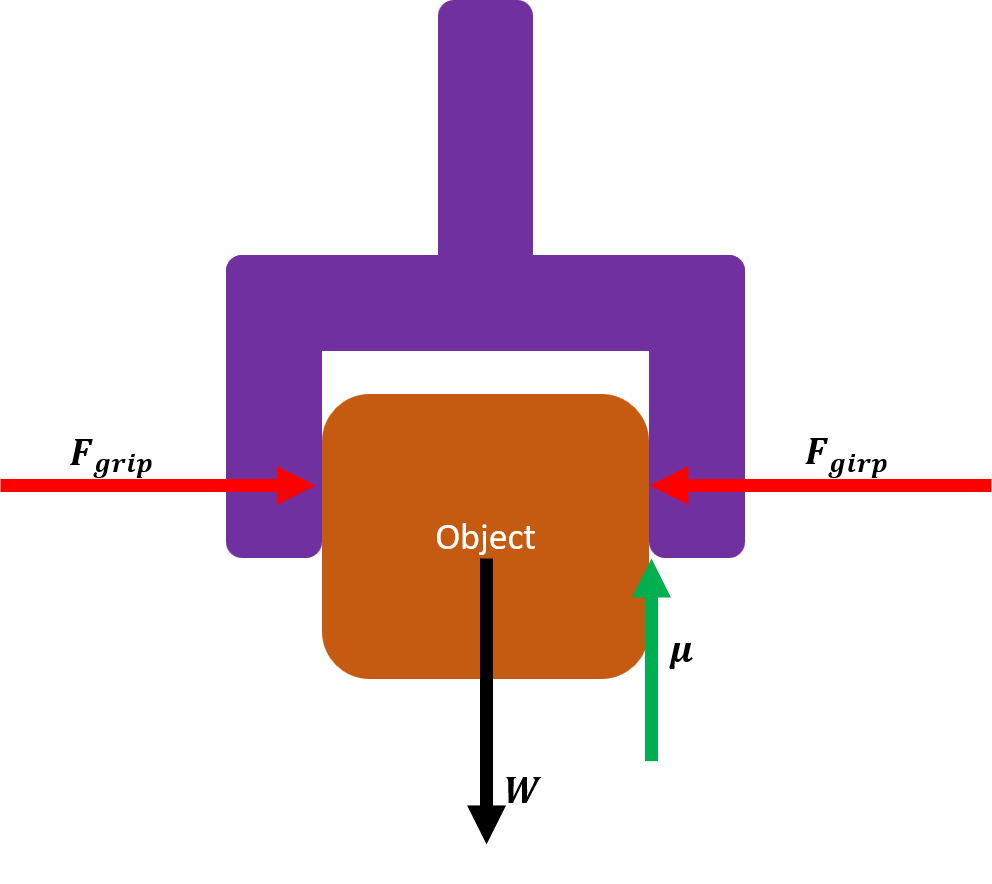
Grasping Force Calculation
For a simple frictional grasp, the total frictional force must be greater than the weight of the object, accounting for dynamic forces. The required normal force exerted by each finger is:
Here: Fgrip is the normal force per finger, \( W \) is the object's weight, \( g \) is a safety factor for acceleration (typically 2-3), n is the number of fingers, and μ is the coefficient of static friction.
Vacuum Grippers
Also known as suction cups, these use a negative pressure differential to lift objects.
Lifting Force Calculation
The lifting force is the product of the pressure difference and the effective area of the cup. To be safe, this must exceed the object's weight, including a safety factor:
$$ F_{lift} = \Delta P. A \gt W.g $$
Here: \( F_{lift} \) is the lifting force, \( \Delta P \) is the pressure difference (vacuum level), \( A \) is the area of the suction cup, \( W \) is the object's weight, and \( g \) is a safety factor.
Magnetic Grippers
These use powerful electromagnets or permanent magnets to handle ferromagnetic materials. Their lifting capacity is determined empirically and specified by the manufacturer, as it depends heavily on the magnetic field strength and the material properties of the workpiece.
Adhesive Grippers
These use a sticky adhesive substance to hold objects. This is a specialized method where the holding force is determined by the chemical adhesion properties of the substance.
Special Tools
In many applications, the robot is not grasping an object but is instead applying a tool to a workpiece. In these cases, the tool itself is the end-effector. Common examples include:
-
Welding torches (for spot or arc welding)
-
Paint spray guns
-
Drills, grinders, and deburring tools
-
Glue or sealant applicators
-
Surgical instruments (e.g., scalpels or forceps on a surgical robot)
Active vs. Passive Grippers
Passive Grippers
The vast majority of industrial grippers are passive. While they are actuated to open and close, they have no integrated sensing capabilities. Their grasp is determined by the pre-programmed motion and force they apply. The success of the grasp relies on the precise positioning of the robot and the known properties of the object.
Active Grippers
These are more advanced grippers that are equipped with their own sensors. This sensory feedback allows for much more delicate and intelligent manipulation, enabling the robot to adapt its grasp in real-time. Examples of sensors used in active grippers include:
-
Force sensors on the fingertips to control the grip force precisely.
-
Tactile sensors to detect the pressure distribution of a grasp, helping to prevent slip.
-
Proximity sensors to aid in positioning the gripper relative to the object before contact is made.
Selection and Design Considerations
Choosing or designing the right end-effector is critical to the success of a robotic application. Key factors include:
-
Part Properties: The size, shape, weight, and material of the object to be handled. Is it fragile? Is it ferromagnetic? Is its surface smooth or rough, porous or non-porous?
-
Task Requirements: What needs to be done with the part? Simple pick-and-place, precise assembly, applying a tool, or delicate handling?
-
Required Force: Based on the calculations above, can the gripper provide sufficient force to securely handle the part throughout the entire motion cycle?
-
Cycle Time: The end-effector must be able to actuate quickly enough to meet the production rate requirements.
-
Environment: Will the gripper be exposed to high temperatures, dust, moisture, or a cleanroom environment?
-
Reliability and Maintenance: The end-effector must be robust enough to withstand millions of cycles with minimal maintenance.
-
Flexibility: If the robot will handle a variety of different parts, a more flexible gripper or even an automatic tool-changing system may be required. An automatic tool changer allows a robot to autonomously swap one end-effector for another, dramatically increasing the versatility of a single robot.